Field Notes Wine Cooler Repair · Bothell
Sub-Zero Wine Cooler Not Holding Its Set Temperature
A Sub-Zero wine unit reading four or five degrees above its setting is usually airflow, seals or a drifting sensor — not a dying compressor. How to tell which one you have before you spend anything.
- Filed
- Reading
- 5 min
- Applies to
- Sub-Zero built-ins · Bothell, WA
- Author of record
- Dean Halvorsen Refrigeration technician — sealed systems and airflow Years at it: 19 EPA 608 certified
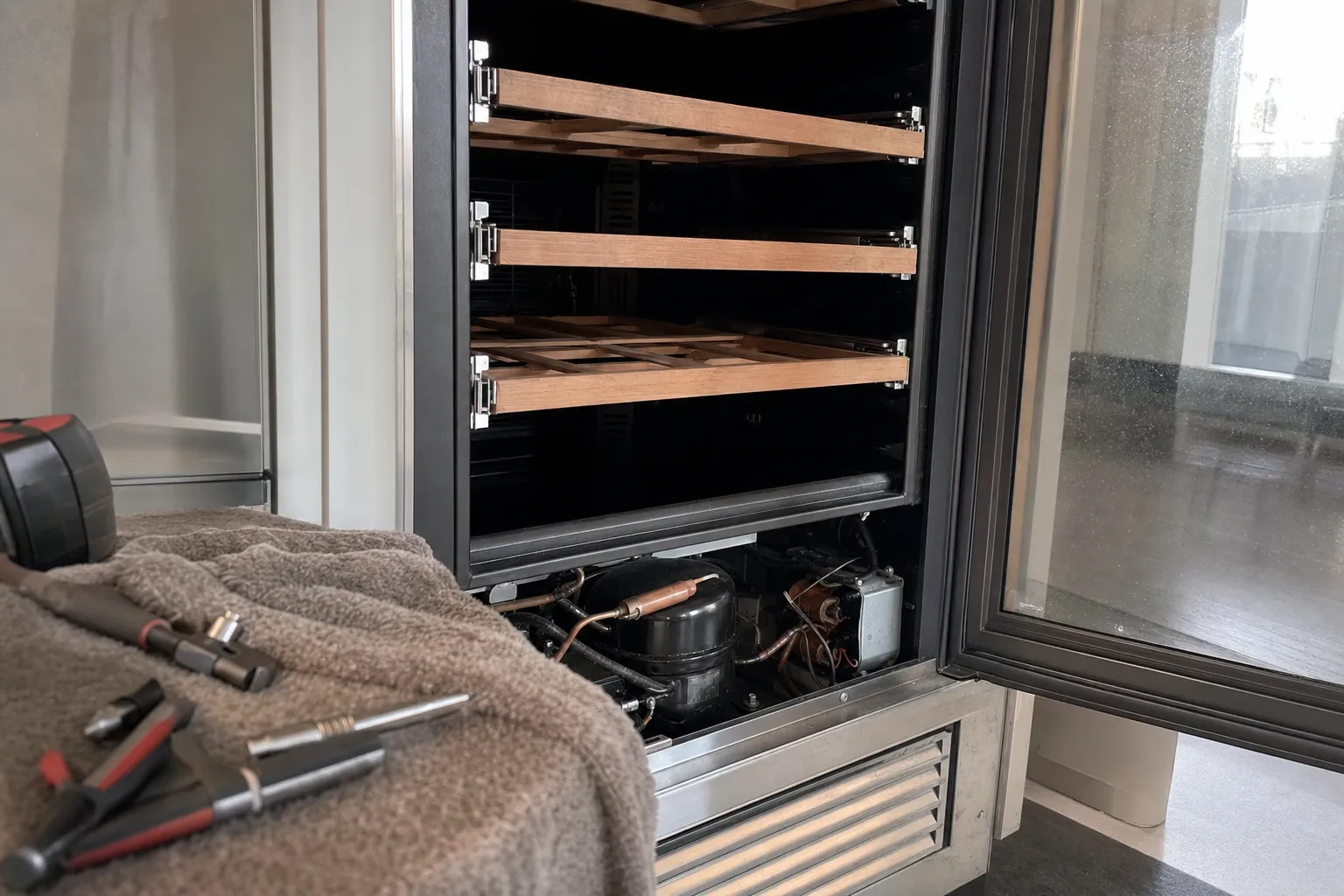
A Sub-Zero wine unit that reads 62°F when it is set to 55°F sounds like a compressor problem, and it very rarely is. On the units we open in Bothell the cause is almost always one of four things, three of which cost far less than people expect. The trick is telling them apart before anyone starts ordering parts.
Wine storage is also the appliance most likely to be misdiagnosed, because it is the one people check least often. A refrigerator gets opened twenty times a day and a fault is obvious within hours. A wine unit can drift for a month before anyone notices, by which time the useful evidence — when it started, what changed — has usually been forgotten.
What “drift” actually means on these units
A Sub-Zero wine cooler is not trying to hold an exact number. It runs a slow cycle and lets the cabinet float a degree or so either side of the setting, which is deliberate: rapid cycling is worse for the wine and worse for the compressor. So a display reading 56°F on a 55°F setting is a healthy unit doing its job.
What is not normal:
- a zone that never reaches its setting, no matter how long it runs
- a gap of four degrees or more that persists across a whole day
- one zone holding perfectly while the other climbs — on a dual-zone unit that is diagnostically loud
- a temperature alarm that appears every morning and clears by mid-afternoon
That last pattern is worth writing down if you see it, because it usually means the unit is losing ground overnight when the kitchen is coolest and the compressor is cycling least. That points at heat load and seals rather than cooling capacity.
Start with the condenser, because it is free
The single most common cause of a warm wine unit in this area is a condenser packed with dust and pet hair. Undercounter units live in cabinetry with a narrow intake grille at floor level, which is exactly where household dust collects. Once that coil is blanketed the unit cannot reject heat, and the cabinet temperature climbs no matter how hard the compressor works.
Pull the lower grille, look at the coil with a torch, and vacuum it with a brush head. If the fins are matted grey, that is very likely your entire problem. Give it 24 hours after cleaning before judging the result — a unit that has been running warm for weeks has a lot of thermal mass in it, and the glass, the shelving and forty bottles of wine all have to come back down.
While the grille is off, put a hand near the condenser fan and confirm it is actually turning. A seized or slow condenser fan produces exactly the same symptom as a blocked coil, and on Bothell units that sit in kitchen islands with limited clearance it is a common enough failure to be worth two seconds of checking.
Seals, doors and the summer problem
The second cause is the door. Wine units use a glass door with a heated or tightly-sealed edge, and the gasket has a harder job than a refrigerator gasket because the glass is a poor insulator to begin with.
Test it properly: close the door on a sheet of paper at six points around the frame — top left, top centre, top right, and the same along the bottom. The paper should drag when you pull it at every point. If it slides out freely anywhere, the seal is not gripping there, and warm room air is being pulled into the cabinet continuously.
Condensation on the inside of the glass is the same story told a different way. It means humid room air is getting in and meeting a cold surface. In this part of Washington that shows up worst between June and September, when the house is warm and damp and the differential across the glass is at its largest. A unit that holds fine all winter and drifts every summer is nearly always a seal or a door-alignment issue, not a cooling one.
Doors also fall out of square over time, particularly on undercounter units that get leaned on. If the gasket is sound but only grips along three sides, the hinge needs adjusting rather than the gasket replacing — a much smaller job.
When it is the sensor, the control or the sealed system
If the coil is clean, the fan turns and the seal grips, the remaining causes are electrical or sealed-system, and this is where measurement replaces guesswork.
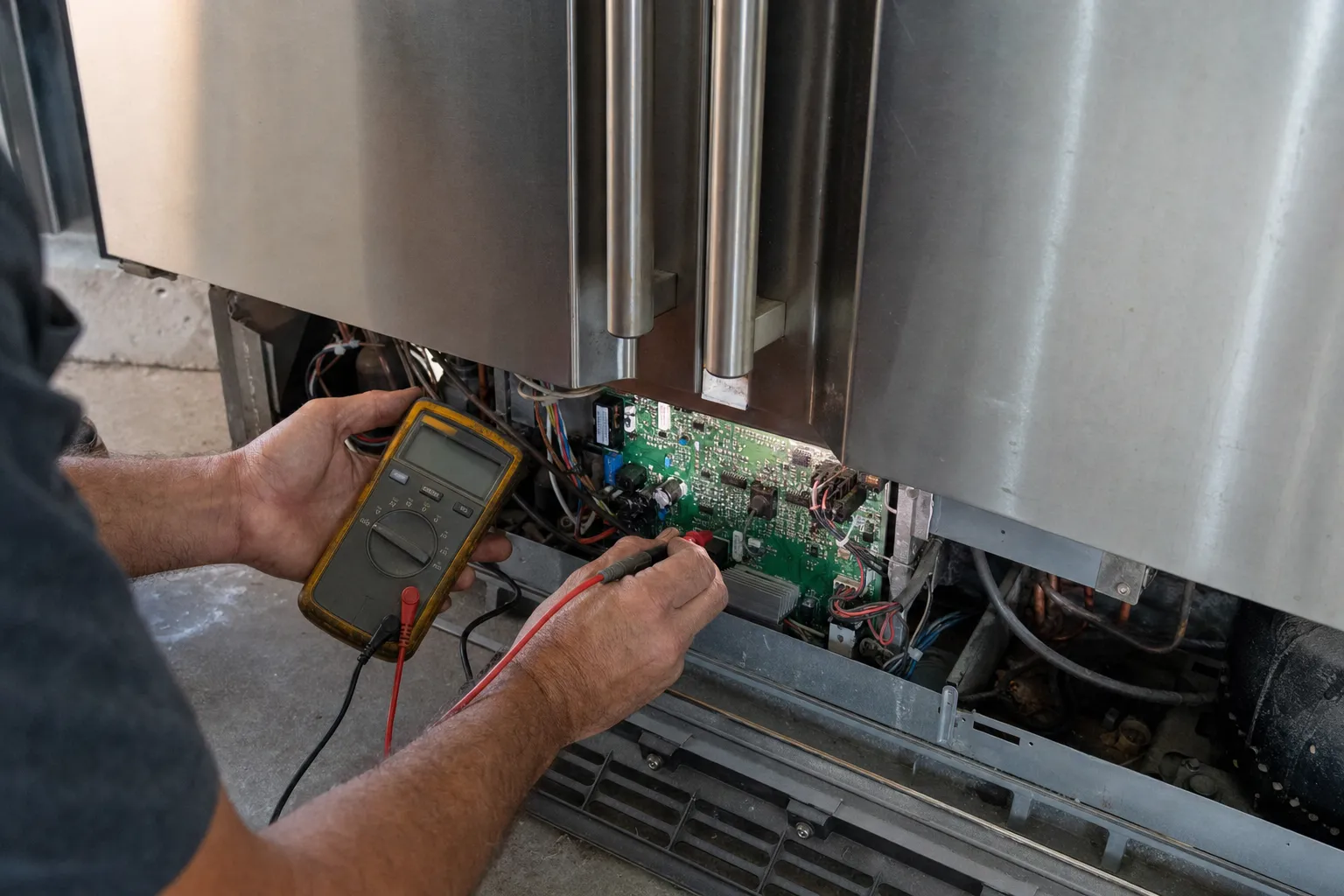
A drifting thermistor is the most common of the three. These sensors do not usually fail outright; they age and start reporting a temperature a few degrees away from reality. The unit then holds that wrong number perfectly, which is why the display can look completely healthy while the cabinet is not. The giveaway is a mismatch between the display and an independent thermometer left in the cabinet for four hours. Any gap over two degrees is worth investigating.
A dual-zone control fault shows up as one zone right and one zone wrong. Each zone has its own sensor and, depending on the generation, its own damper or evaporator circuit. One zone failing while the other holds rules out the compressor and the charge immediately — both zones share those. That single observation saves a lot of money, so it is always worth reporting on the phone.
A sealed-system fault — a leak, a restriction, a failing compressor — is the least common and the only one that is genuinely expensive. It looks like a unit that runs constantly and still climbs, often with a compressor that is hot to the touch and a condenser that is barely warm. That combination needs gauges and EPA 608 certification, and refrigerant is weighed in rather than topped up. If somebody offers to “add a bit of gas” without locating the leak, the charge will be gone again within a year.
What is worth doing before you call
Spend twenty minutes on this and you will either fix it or hand over a much better diagnosis:
- Vacuum the condenser coil and confirm the condenser fan spins.
- Put a glass of water with a thermometer in the affected zone and read it four hours later. Write down both that number and the display number.
- Paper-test the door seal at six points.
- Note whether one zone or both are affected, and whether it is worse overnight.
Those four data points narrow a wine cooler fault to one or two causes before a technician has opened anything, which usually means the right part is on the van and the job finishes on the first visit rather than the second.
Follow-up questions
- How much drift is normal on a Sub-Zero wine unit?
- A degree or two either side of the setting, cycling slowly through the day, is normal and by design — the compressor is not running constantly to hold a knife-edge number. Persistent drift of four degrees or more, or a zone that never reaches its setting at all, is a fault.
- Can I fix a wine cooler that is warm in the upper zone myself?
- You can rule out the cheap causes: vacuum the condenser, check nothing is blocking the internal vents, confirm the door closes squarely and the seal grips a sheet of paper all the way round. If it still drifts after 24 hours, the remaining causes are electrical or sealed-system and need gauges and a meter.
- Does a wine cooler need a different refrigerant charge to a refrigerator?
- The charge is model-specific and weighed in to the gram, which is why a leak repair is never a top-up. If a technician suggests adding refrigerant without finding the leak first, get a second opinion — the charge will be gone again by next summer.
- Is it worth repairing a 15-year-old undercounter wine unit?
- Usually yes for control, fan, seal and thermostat faults, which are ordinary parts-and-labour repairs and a fraction of what the unit is worth. A failed compressor in a 15-year-old undercounter unit is the one case where replacement often makes more sense, and we will say so on site rather than sell the repair.